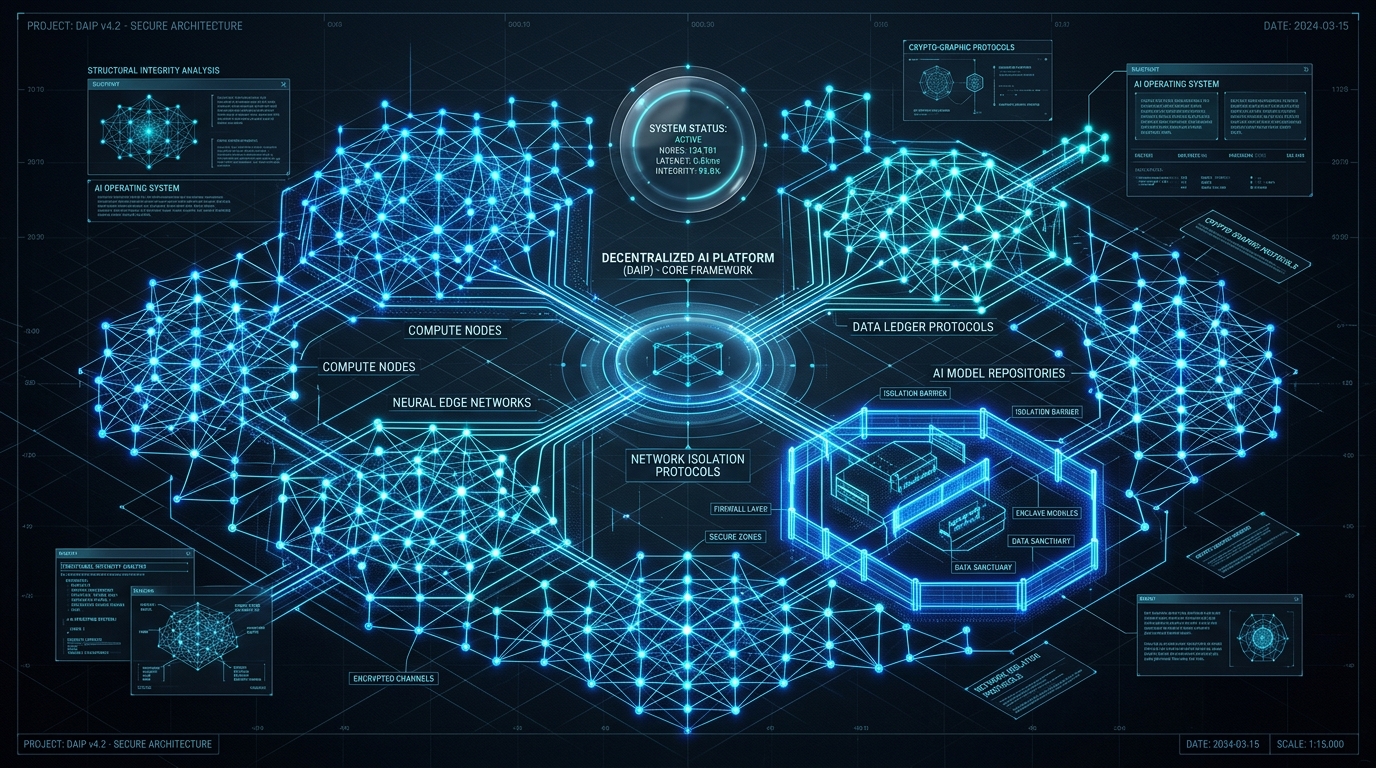
"Decentralized" is a word that gets used loosely enough in technology marketing that I understand if it sounds like jargon rather than a real commitment. I want to make it concrete, because it is the single most consequential decision behind every platform Laurenvil Enterprises designs, and it is the decision that determines whether the three problems named in Article 01 actually get solved, or just get hidden behind a nicer interface.
There are three separate engineering commitments hiding inside that one word. I will take them in order: isolation, resilience, and locality. None of them is optional in the systems we build, and every one of them is something you can ask a vendor about directly, in plain language, and expect a plain answer.
Isolation: your data lives in a walled compartment, not a shared pool
The first commitment is the one that matters most to a board member worried about a data breach. Your institution's information is never mixed with anyone else's, even when the underlying infrastructure is shared.
This sounds obvious until you understand how most multi-client software is actually built. It is common, and often perfectly reasonable, for a vendor to run every customer's data through the same database, distinguished only by a label attached to each record: this school's rows carry one tag, that district's rows carry another. That approach can be built safely. It can also fail in exactly one way that matters: a single missed check, in a single query, in a single corner of the system, and one institution's records become visible from another institution's account. It has happened to well-resourced companies. It is not a hypothetical.
The architecture we build treats that missed check as the single most dangerous class of bug in the entire system, worth naming explicitly rather than trusting to good intentions. Every table of institutional data carries its institution's identifier as a first-class, structurally required part of its design, not an optional field a developer might forget to filter by. Every query is checked against it before it runs, and the database itself is configured to refuse a query that does not name which institution it is asking about. A mistake in the application code fails safely, at the data layer, instead of leaking silently.
Isolation is also why "decentralized" does not mean "everyone gets their own separate server." A single well-built shared platform, correctly isolated, gives every institution the benefits of shared engineering investment (reliability, ongoing improvement, lower cost) without any of the risk of shared data. The isolation is architectural, not physical, and that distinction is the whole engineering problem. It is also a solvable one.
Resilience: no single vendor's outage should ever be your outage
The second commitment addresses a risk almost nobody thinks about until the day it happens: what occurs in your classroom or your office the moment the AI provider your platform depends on goes down.
Every AI platform, including the ones built by the largest companies in the world, ultimately depends on calling out to a language model somewhere. Sometimes one it owns, more often, underneath the branding, one of a handful of large providers that most of the industry quietly shares. When that provider has an outage, a platform with a single dependency on it goes down with it, in the middle of a lesson, in the middle of a training session, with no graceful failure and no warning.
The systems we build are engineered around a different assumption: outages are not an edge case, they are a certainty, and the architecture has to expect them. Every AI call in a platform we design is routed through a chain of independent providers rather than a single one. A preferred path first, and if that path does not answer, an automatic failover to the next, and the next after that, invisibly, without the person using the platform ever noticing anything happened. The system is built so that a single provider's bad afternoon is absorbed silently, rather than becoming your incident report.
That last point deserves its own emphasis, because it is what actually protects an institution over the long run. The platform is built against an open, portable standard for how it talks to an AI model, rather than being wired permanently into one company's proprietary system. That means the specific provider behind the scenes can be swapped, renegotiated, or replaced entirely as pricing and capability shift. It gives an institution real negotiating room, instead of the vendor lock-in that only ever benefits the vendor.
Locality: from fully cloud-hosted to fully in your building
The third commitment is the one that goes furthest toward what most people mean when they first hear "decentralized," and it is genuinely a spectrum, not a single choice.
That third option is not theoretical for us. Before it was a service offering, it was a proof of concept: an AI assistant running entirely on a single, inexpensive computing board, the kind of hardware that costs less than a classroom textbook set, with no cloud connection required at all. We built it specifically to demonstrate something the industry rarely says out loud. Cloud dependency for AI is a business decision, not a technical requirement. It is the easiest way to sell AI. It is not the only way to run it.
This is not an all-or-nothing choice. A common and often correct pattern is a hybrid: routine, lower-sensitivity work runs through the managed cloud platform for speed and cost efficiency, while the handful of workflows touching your most sensitive information run on infrastructure that never leaves your building. The architecture is designed so that decision can be made feature by feature, not as one irreversible commitment made on day one.
Next in this series: 03 · The Cognitive Layer That Knows Your Organization, what it takes, architecturally, to build a system that actually adapts to the individual in front of it instead of the average person.
David Laurenvil is the Principal Consultant of Laurenvil Enterprises. He has spent nearly twenty years in business and STEM education leadership, including as Director of Education at the Fleet Science Center in San Diego, CA, and Executive Director of Kids MakeIt Institute. He designs and builds AI-native educational platforms and decentralized AI infrastructure for schools, districts, and organizations.